Sunday, November 7, 2010
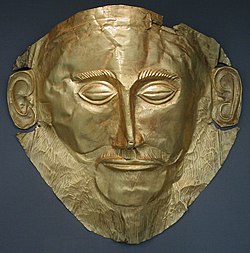
Mask of Agamemnon

Saturday, November 6, 2010
Works Cited
The Encyclopaedia Britannica, Volume 19 pg 260. Thomas Spencer Baynes.
"Agamemnon" The Concise Oxford Companion to Classical Literature. Ed. M.C. Howatson and Ian Chilvers. Oxford University Press, 1996. Oxford Reference Online. Oxford University Press. Central Washington University. 7 November 2010 <http://www.oxfordreference.com/views/ENTRY.html?subview=Main&entry=t9.e89>
"Agamemnon" The Concise Oxford Companion to Classical Literature. Ed. M.C. Howatson and Ian Chilvers. Oxford University Press, 1996. Oxford Reference Online. Oxford University Press. Central Washington University. 7 November 2010 <http://www.oxfordreference.com/views/ENTRY.html?subview=Main&entry=t9.e89>
Before and After
To help actors understand this play more, I'll be giving some background about Agamemnon, both the play and the person, as well as some information about what happens after the play.
Before the play begins, Agamemnon is just coming back from being the leader of the Greek forces in the Trojan War. This is all explained, but what isn't is a few details of the war. One such is that Agamemnon sacrificed his daughter, Iphigeneia, "to atom for an offence against Artemis, who in anger was keeping the Greek fleet wind-bound at Aulis" (ORO). Something interesting about this play, is that Aegisthus, Clytemnestra's lover, is the son of Thyestes, who was fed his own sons by Atreus, who is the father of Agamemnon and who raised Aegisthus as his own son, even though Thyestes was his actual father.
Agamemnon has at least two other children though, Electra and Orestes. After the play, as the chorus predicts in the play, Orestes comes back with the help of Electra and kills Aegisthus.
Before the play begins, Agamemnon is just coming back from being the leader of the Greek forces in the Trojan War. This is all explained, but what isn't is a few details of the war. One such is that Agamemnon sacrificed his daughter, Iphigeneia, "to atom for an offence against Artemis, who in anger was keeping the Greek fleet wind-bound at Aulis" (ORO). Something interesting about this play, is that Aegisthus, Clytemnestra's lover, is the son of Thyestes, who was fed his own sons by Atreus, who is the father of Agamemnon and who raised Aegisthus as his own son, even though Thyestes was his actual father.
Agamemnon has at least two other children though, Electra and Orestes. After the play, as the chorus predicts in the play, Orestes comes back with the help of Electra and kills Aegisthus.
Altogether, an Intoduction
Welcome to my blog! Here I will be posting various parts of research I have done on the Greek play Agamemnon. The research will range from historical facts about the time period in which Agamemnon was written, to how the play should be read and what to take from it. Today, we will be touching on the latter, specifically how the play, or any Greek play for that matter, should be read.
First of all, Agamemnon was written in a time that we know relatively little about, when compared to the last few hundred years.With that in mind, looking at the script of a Greek play can be very daunting. It's all written as poetry is, though it doesn't rhyme, or have a poetic scheme. Some people want to read it as though it has breaks, but really it's all perfectly fluid, just like you would read this blog.
Another part of reading Greek plays that trips people up is the syntax in which the plays are written in. Generally the syntax is the most poetic part of the play; gorgeous visuals and well paired phrases are what makes these plays so interesting. As Thomas Spencer Baynes put it in The Encyclopaedia Britannica, "...even in Homer's description of the sheild of Achilles, even in the famous description by Sophocles of his native woods in Oedipus Coloneus, such word-painting as occurs seems, if not inevitable and unconcious, so alive with imaginative feeling as to become part and parcel of the dramatic or lyric movement itself" (Volume 19, pg 260).
Unfortunately for us, the same thing that makes these plays so amazing is the same thing that keeps an average person from reading them. They will often read a passage, then, not understanding it, give up. The best way to understand the language used in these plays is to do two things: read the passages out loud, then read them multiple times. The first allows you to take in the information not only visually, but orally as well. Then, once you repeat it to yourself, it's easier to extract the meanings from the complicated syntax.
First of all, Agamemnon was written in a time that we know relatively little about, when compared to the last few hundred years.With that in mind, looking at the script of a Greek play can be very daunting. It's all written as poetry is, though it doesn't rhyme, or have a poetic scheme. Some people want to read it as though it has breaks, but really it's all perfectly fluid, just like you would read this blog.
Another part of reading Greek plays that trips people up is the syntax in which the plays are written in. Generally the syntax is the most poetic part of the play; gorgeous visuals and well paired phrases are what makes these plays so interesting. As Thomas Spencer Baynes put it in The Encyclopaedia Britannica, "...even in Homer's description of the sheild of Achilles, even in the famous description by Sophocles of his native woods in Oedipus Coloneus, such word-painting as occurs seems, if not inevitable and unconcious, so alive with imaginative feeling as to become part and parcel of the dramatic or lyric movement itself" (Volume 19, pg 260).
Unfortunately for us, the same thing that makes these plays so amazing is the same thing that keeps an average person from reading them. They will often read a passage, then, not understanding it, give up. The best way to understand the language used in these plays is to do two things: read the passages out loud, then read them multiple times. The first allows you to take in the information not only visually, but orally as well. Then, once you repeat it to yourself, it's easier to extract the meanings from the complicated syntax.
Subscribe to:
Posts (Atom)